Research Projects
Research Interests
I am trained as an applied and computational mathematician, aiming to strike a balance between mathematical modeling, numerical analysis, and high-performance simulation; my application domains are multiphase complex fluids and mathematical biology. My research is highly interdisciplinary, sitting at the interface of applied mathematics, scientific computing, soft matter physics, and mathematical biology. Here are several projects I have been working on:
- Machine learning and deep neural networks for PDE model discovery and for solving partial differential equations
- Computational modeling of how living cells use liquid–liquid phase separation (LLPS) to organize chemical compartments
- Hydrodynamic models of biofilms (biofilm formation, antimicrobial persistence, quorum sensing)
- Modeling eukaryotic cell mitotic dynamics (mitotic rounding, cell oscillation, cell motility, and cytokinesis)
- Complex fluid model development (multiphase fluids, active liquid crystals, viscoelastic fluids)
- Fluid–structure interactions (FSI) in complex fluids, with applications in biology and medicine
- Modeling and design of multifunctional polymeric rod-like nanocomposites
- Accurate, efficient, and stable numerical schemes for multiphase complex fluid models
- Software development on hybrid CPU–GPU architectures
Selected Research Grants
External Grants
- 2027–2029, National Science Foundation DMS-2625825, Co-PI, with PI Q. Zhang and Co-PIs M. Rahman and F. Hu
- 2025–2028, National Science Foundation CAIG-2530564, Co-PI, with PI J. M. Frame and Co-PIs F. Hu and Y. Zhang
- 2025–2028, National Science Foundation DMS-2513764, Sole PI
- 2024–2025, NeuralMetrics.ai, Sole PI
- 2021–2024, National Science Foundation DMS-2111479/DMS-2405605, Sole PI
- 2021–2024, National Institutes of Health R35-GM143194, Co-Investigator, NIGMS; with PI Y. Huang and Co-Investigator K. Moon
- 2021–2022, National Science Foundation DMS-2114592 (conference), Co-PI, with PI L. F. Gordillo and Co-PI J. Powell
- 2020–2022, S&P Global Ratings, Sole PI
- 2019–2022, National Institutes of Health R15-GM132877, Co-Investigator, NIGMS; with PI Y. Huang and Co-Investigator T. Truscott
- 2018–2021, National Science Foundation DMS-1816783, Sole PI
- 2018, 2022, NVIDIA, Sole PI, Academic Hardware Award, one Quadro P6000 and three RTX A5000 GPUs
- 2016–2018, Simons Foundation, Sole PI, AMS–Simons Travel Grant
Internal Grants
- 2026–2027, The University of Alabama, PI, Southern Regional Drug Data Research Center; with Co-PIs C. Wang and Y. Li
- 2026–2027, The University of Alabama, PI, CARSCA Grant, Barefield College of Arts & Sciences; with Co-PI C. Wang
- 2025–2026, The University of Alabama, Sole PI, Instructional Tide Teaching Grant, UA Teaching Academy
- 2025–2026, The University of Alabama, Sole PI, SEC Faculty Travel Grant, Office of Research & Economic Development
- 2024–2025, Binghamton University, PI, Interdisciplinary Collaborations Grant, with Co-PI C. Cheng
- 2022–2023, Utah State University, Sole PI, Open Education Resource Grant, Utah State University Library
- 2018–2019, Utah State University, Sole PI, Research Catalyst Grant, Office of Research and Graduate Studies
Some Active Research Topics
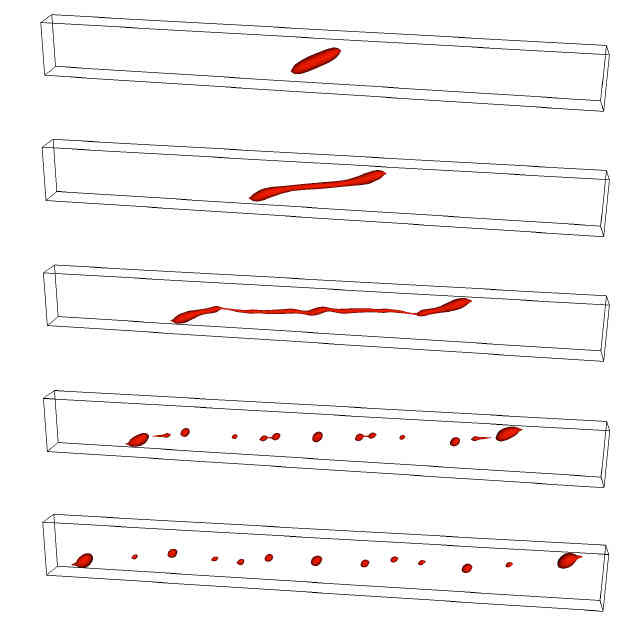
Energy-stable and structure-preserving schemes
Thermodynamically consistent PDEs dissipate a free energy along their solutions. I design time integrators that inherit this dissipation exactly, with no time-step restriction: energy quadratization (EQ and IEQ), scalar auxiliary variable and Lagrange multiplier methods, supplementary variable methods, operator-splitting and decoupled schemes, and arbitrarily high-order variants. Current work, supported by NSF DMS-2513764, targets reversible-irreversible systems where the dissipative and conservative parts must be treated together.
54 related publications; the full list is on the Publications page.
Representative papers
- Numerical approximations for the molecular beam epitaxial growth model based on the invariant energy quadratization methodX. Yang*, J. Zhao and Q. Wang · Journal of Computational Physics, 2017 · DOI
- Numerical approximations for a three-component Cahn-Hilliard phase-field model based on the invariant energy quadratization methodX. Yang*, J. Zhao, Q. Wang and J. Shen · Mathematical Models and Methods in Applied Sciences, 2017 · DOI
- Numerical approximations for a phase field dendritic crystal growth model based on the invariant energy quadratization approachJ. Zhao, Q. Wang and X. Yang* · International Journal for Numerical Methods in Engineering, 2017 · DOI
- Improving the accuracy and consistency of the scalar auxiliary variable (SAV) method with relaxationM. Jiang, Z. Zhang♠ and J. Zhao* · Journal of Computational Physics, 2022 · DOI
- Linear, second order and unconditionally energy stable schemes for the viscous Cahn-Hilliard equation with hyperbolic relaxation using the invariant energy quadratization methodX. Yang*, J. Zhao and X. He · Journal of Computational and Applied Mathematics, 2018 · DOI
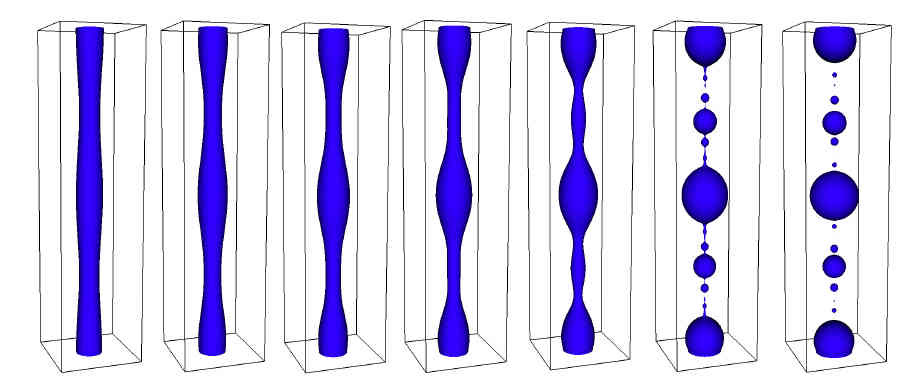
Phase-field modeling and simulation
Phase-field models describe interfaces through smooth order parameters and appear everywhere from alloy solidification to vesicle membranes. I work on Cahn–Hilliard and Allen–Cahn type systems, phase-field crystal and molecular beam epitaxy models, grain growth, and hydrodynamic phase-field models of soft matter, with an emphasis on fast spectral and finite-element solvers.
57 related publications; the full list is on the Publications page.
Representative papers
- On linear and unconditionally energy stable algorithms for variable mobility Cahn-Hilliard type equation with logarithmic Flory-Huggins potentialX. Yang* and J. Zhao · Communications in Computational Physics, 2019 · DOI
- An accurate and efficient algorithm for the time-fractional molecular beam epitaxy model with slope selectionL. Chen, J. Zhang, J. Zhao*, W. Cao, H. Wang and J. Zhang · Computer Physics Communications, 2019 · DOI
- Second order fully discrete energy stable methods on staggered grids for hydrodynamic phase field models of binary viscous fluidsY. Gong, J. Zhao and Q. Wang* · SIAM Journal on Scientific Computing, 2018 · DOI
- A novel second-order linear scheme for the Cahn-Hilliard-Navier-Stokes equationsL. Chen and J. Zhao* · Journal of Computational Physics, 2020 · DOI
- Decoupled energy stable schemes for a phase field model of three-phase incompressible viscous fluid flowJ. Zhao, H. Li, Q. Wang and X. Yang* · Journal of Scientific Computing, 2017 · DOI
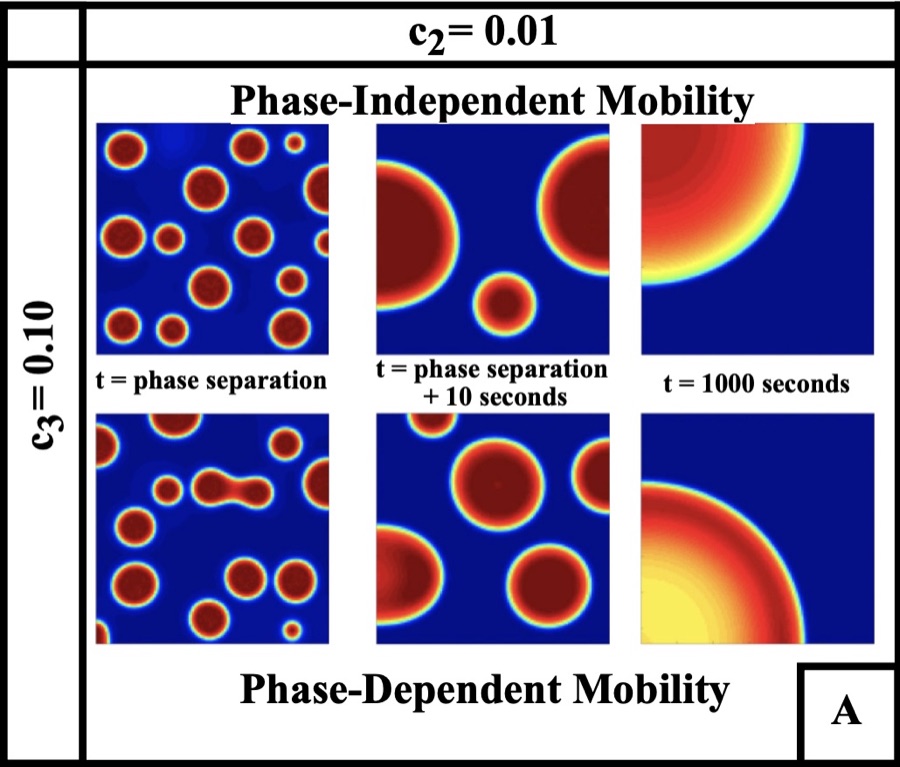
Multiphase complex fluids and soft matter
Multiphase flows, liquid crystals, viscoelastic fluids, active matter, and fluid–structure interaction: I derive continuum and kinetic models for these systems using the generalized Onsager principle, so that the resulting hydrodynamic equations are consistent with the second law, and then simulate them with the schemes above.
28 related publications; the full list is on the Publications page.
Representative papers
- A novel linear, second order, unconditionally energy-stable scheme for a hydrodynamic Q-tensor model for liquid crystalsJ. Zhao, X. Yang, Y. Gong and Q. Wang* · Computer Methods in Applied Mechanics and Engineering, 2017 · DOI
- Energy stable numerical schemes for a hydrodynamic model of nematic liquid crystalsJ. Zhao, X. Yang, J. Li and Q. Wang* · SIAM Journal on Scientific Computing, 2016 · DOI
- Fully discrete second-order linear schemes for hydrodynamic phase field models of binary viscous fluid flows with variable densitiesY. Gong, J. Zhao, X. G. Yang and Q. Wang · SIAM Journal on Scientific Computing, 2018 · DOI
- A decoupled energy stable scheme for a hydrodynamic phase-field model of mixtures of nematic liquid crystals and viscous fluidsJ. Zhao, X. Yang, J. Shen and Q. Wang* · Journal of Computational Physics, 2016 · DOI
- Numerical approximations to a new phase field model for two phase flows of complex fluidsJ. Zhao, Q. Wang and X. Yang* · Computer Methods in Applied Mechanics and Engineering, 2016 · DOI
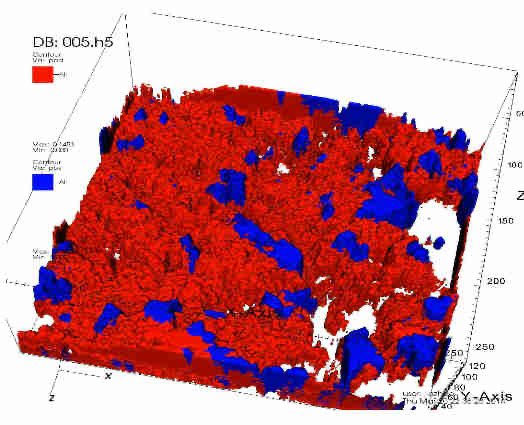
Mathematical biology
Applications include the mechanics of eukaryotic cells (mitotic rounding, oscillation, motility, cytokinesis), liquid–liquid phase separation as a way cells organize chemical compartments, hydrodynamic models of bacterial and algal biofilms (formation, antimicrobial persistence, quorum sensing), and networked epidemic models whose agents are driven by generative AI.
13 related publications; the full list is on the Publications page.
Representative papers
- Experimental and theoretical investigation of multispecies oral biofilm resistance to chlorhexidine treatmentY. Shen△, J. Zhao△, C. de la Fuente-Núñez, Z. Wang, R. E. W. Hancock, C. R. Roberts, J. Ma, J. Li, M. Haapasalo* and Q. Wang* · Scientific Reports, 2016 · DOI
- A 3D numerical study of antimicrobial persistence in heterogeneous multi-species biofilmsJ. Zhao, Y. Shen, M. Haapasalo, Z. Wang and Q. Wang* · Journal of Theoretical Biology, 2016 · DOI
- Modeling the excess cell surface stored in a complex morphology of bleb-like protrusionsM. Kapustina*, D. Tsygankov△, J. Zhao△, T. Wessler, X. Yang, A. Chen, N. Roach, T. C. Elston, Q. Wang*, K. Jacobson* and M. G. Forest* · PLOS Computational Biology, 2016 · DOI
- Three-dimensional numerical simulations of biofilm dynamics with quorum sensing in a flow cellJ. Zhao and Q. Wang* · Bulletin of Mathematical Biology, 2017 · DOI
- Modeling cytokinesis of eukaryotic cells driven by the actomyosin contractile ringJ. Zhao and Q. Wang* · International Journal for Numerical Methods in Biomedical Engineering, 2016 · DOI
Scientific machine learning
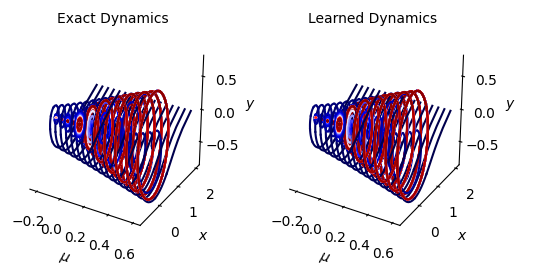
Data-driven discovery of PDE models, physics-informed neural networks for forward and inverse problems, and reduced-order models that keep the structure of the full system. The goal is to combine what the data says with what the physics already guarantees.
6 related publications; the full list is on the Publications page.
Representative papers
- Solving Allen-Cahn and Cahn-Hilliard equations using the adaptive physics informed neural networksC. L. Wight♠ and J. Zhao* · Communications in Computational Physics, 2021 · DOI
- Discovering phase field models from image data with the pseudo-spectral physics informed neural networksJ. Zhao* · Communications on Applied Mathematics and Computation, 2021 · DOI
- A physics-informed structure-preserving numerical scheme for the phase-field hydrodynamic model of ternary fluid flowsQ. Hong, Y. Gong and J. Zhao* · Numerical Mathematics: Theory, Methods and Applications, 2023 · DOI
- Numerical approximations of the Allen-Cahn-Ohta-Kawasaki (ACOK) equation with modified physics informed neural networks (PINNs)J. Xu, J. Zhao and Y. Zhao* · International Journal of Numerical Analysis and Modeling, 2023 · DOI
- General numerical framework to derive structure preserving reduced order models for thermodynamically consistent reversible-irreversible PDEsZ. Zhang♠ and J. Zhao* · Journal of Computational Physics, 2025 · DOI
Scientific software on CPU–GPU architectures
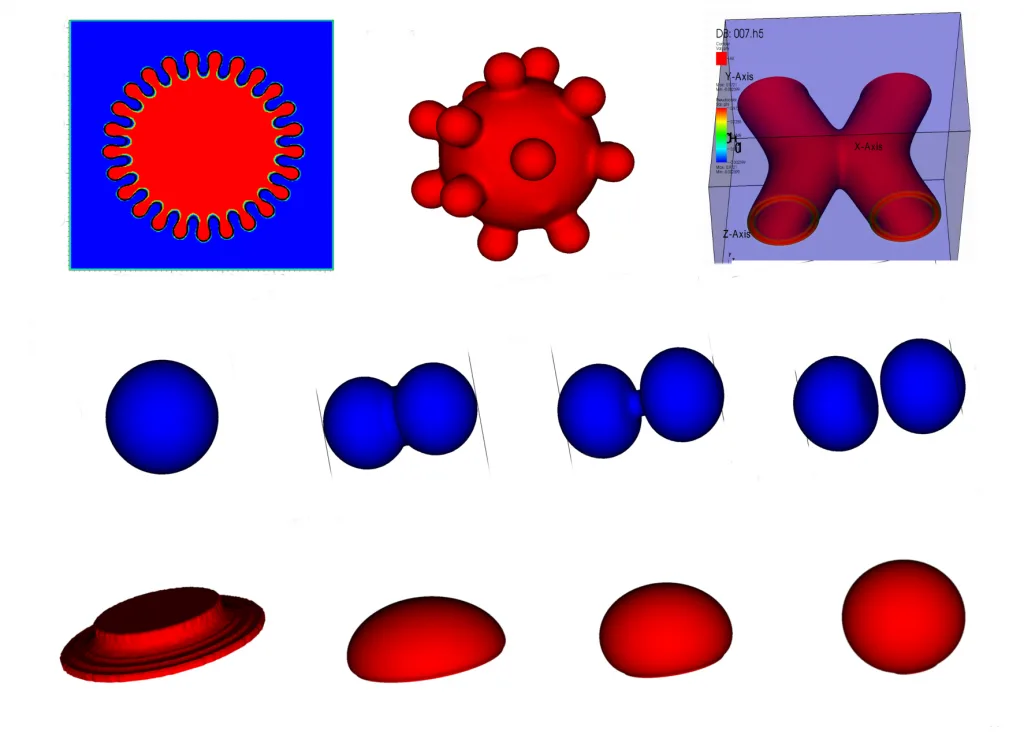
Spectral and finite-difference solvers for phase-field and fractional PDE models, implemented for hybrid CPU–GPU hardware so that three-dimensional simulations over long time horizons are routine rather than heroic.
13 related publications; the full list is on the Publications page.
Representative papers
- Time-fractional Allen-Cahn and Cahn-Hilliard phase-field models and their numerical investigationH. Liu, A. Cheng, H. Wang* and J. Zhao · Computers & Mathematics with Applications, 2018 · DOI
- Arbitrarily high-order linear energy stable schemes for gradient flow modelsY. Gong, J. Zhao and Q. Wang* · Journal of Computational Physics, 2020 · DOI
- Arbitrarily high-order unconditionally energy stable SAV schemes for gradient flow modelsY. Gong, J. Zhao* and Q. Wang · Computer Physics Communications, 2020 · DOI
- Regularized linear schemes for the molecular beam epitaxy model with slope selectionL. Chen, J. Zhao* and X. Yang · Applied Numerical Mathematics, 2018 · DOI
- On power law scaling dynamics for time-fractional phase field models during coarseningJ. Zhao, L. Chen* and H. Wang · Communications in Nonlinear Science and Numerical Simulation, 2019 · DOI