C2FD
A 3D toolkit for computational complex-fluid dynamics
Introduction
C2FD solves hydrodynamic models of complex fluids in two and three dimensions on hybrid CPU–GPU hardware. The project started in 2008 in Qi Wang's group at the University of South Carolina; I am its maintainer and main active developer. The established models ship as tutorial examples, each with an energy-stable scheme implemented on GPUs, and physical boundary conditions are selected through parameter files.
It contains solvers in 2D and 3D for
- Navier–Stokes equations with variable density and viscosity
- Viscoelastic constitutive models: Oldroyd-B, Giesekus, PTT, FENE-P and Rolie-Poly
- Cahn–Hilliard and Allen–Cahn phase-field equations
- Convection–diffusion–reaction equations with non-homogeneous diffusion tensors
Project Information
- Project leaders
- Qi Wang (University of South Carolina) and Jia Zhao
- Developers
- X. P. Zhao, Y. Z. Gong and Y. C. Zhao
- Contributors
- P. Seeluangsawat, M. M. Ren and C. Chen
Architecture
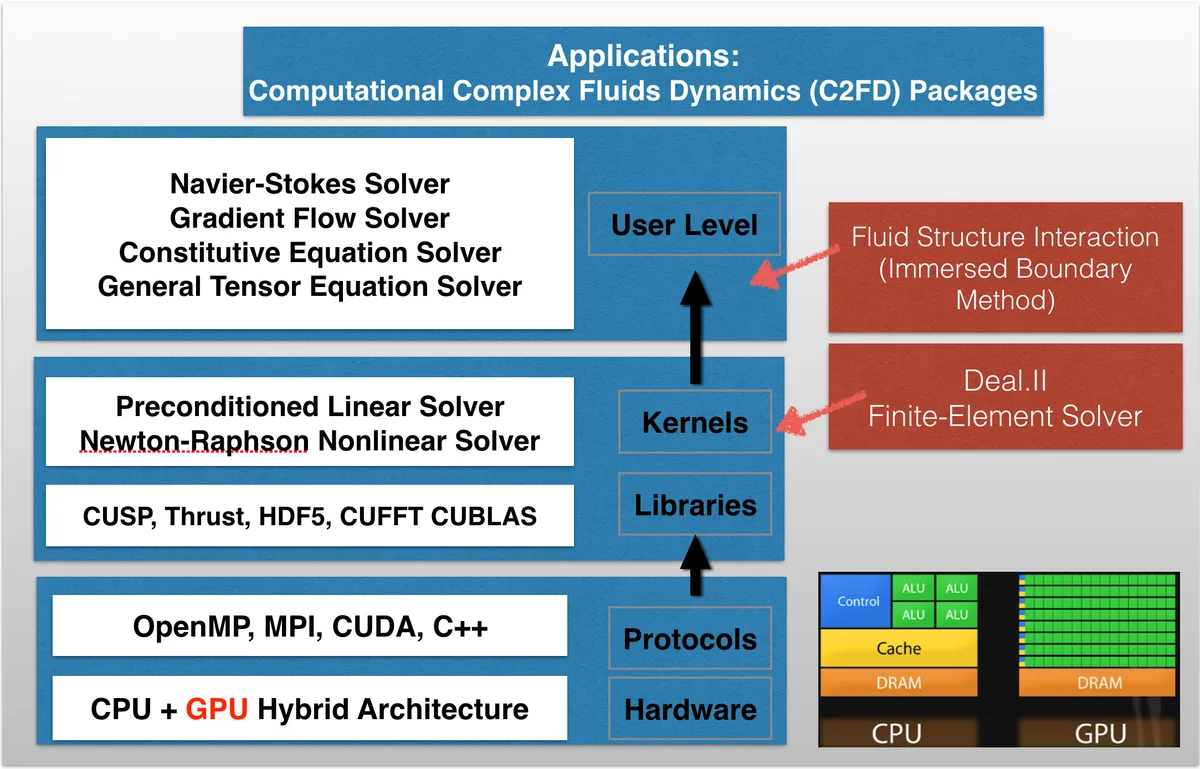
- Solvers
- Navier–Stokes, gradient-flow, constitutive-equation and general tensor-equation solvers
- Kernels
- Preconditioned linear solver; Newton–Raphson nonlinear solver
- Libraries
- CUSP, Thrust, HDF5, cuFFT, cuBLAS
- Protocols
- OpenMP, MPI, CUDA, C++
- Hardware
- Hybrid CPU + GPU architecture
- Extensions
- Fluid–structure interaction by the immersed boundary method; the deal.II finite-element library
Applications
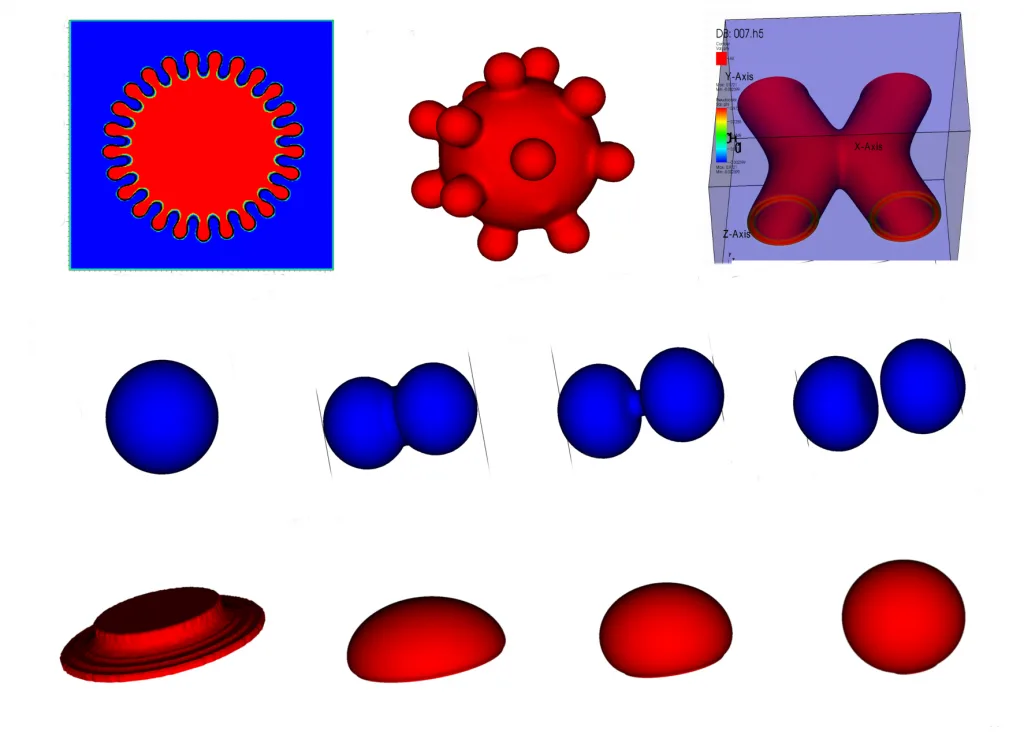
Papers with GPU Implementations
Papers whose numerical schemes were implemented on GPUs.
- Numerical approximations for the molecular beam epitaxial growth model based on the invariant energy quadratization methodX. Yang*, J. Zhao and Q. Wang · Journal of Computational Physics, 2017 · DOI
- A novel linear, second order, unconditionally energy-stable scheme for a hydrodynamic Q-tensor model for liquid crystalsJ. Zhao, X. Yang, Y. Gong and Q. Wang* · Computer Methods in Applied Mechanics and Engineering, 2017 · DOI
- A decoupled energy stable scheme for a hydrodynamic phase-field model of mixtures of nematic liquid crystals and viscous fluidsJ. Zhao, X. Yang, J. Shen and Q. Wang* · Journal of Computational Physics, 2016 · DOI
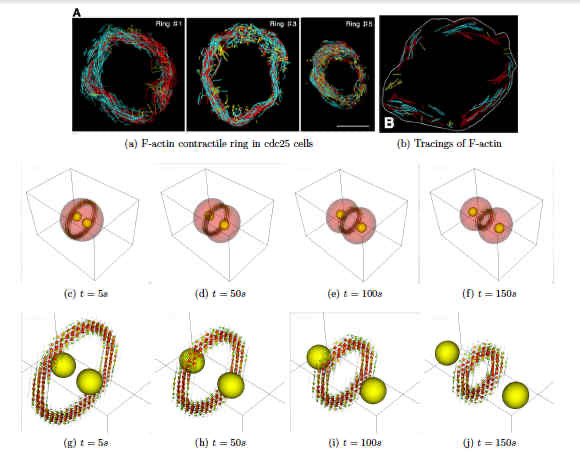
- Modeling cytokinesis of eukaryotic cells driven by the actomyosin contractile ringJ. Zhao and Q. Wang* · International Journal for Numerical Methods in Biomedical Engineering, 2016 · DOI
- A 3D numerical study of antimicrobial persistence in heterogeneous multi-species biofilmsJ. Zhao, Y. Shen, M. Haapasalo, Z. Wang and Q. Wang* · Journal of Theoretical Biology, 2016 · DOI
- Modeling antimicrobial tolerance and treatment of heterogeneous biofilmsJ. Zhao*, P. Seeluangsawat and Q. Wang · Mathematical Biosciences, 2016 · DOI